
AI News 5 min read
Your documents are already in Public AI Tools. Do you know where?
 Ilona Yarmolovska
 Your team may already be using public AI tools to process contracts, invoices, and KYC files. Here’s why that creates a hidden document workflow risk.
Ilona Yarmolovska 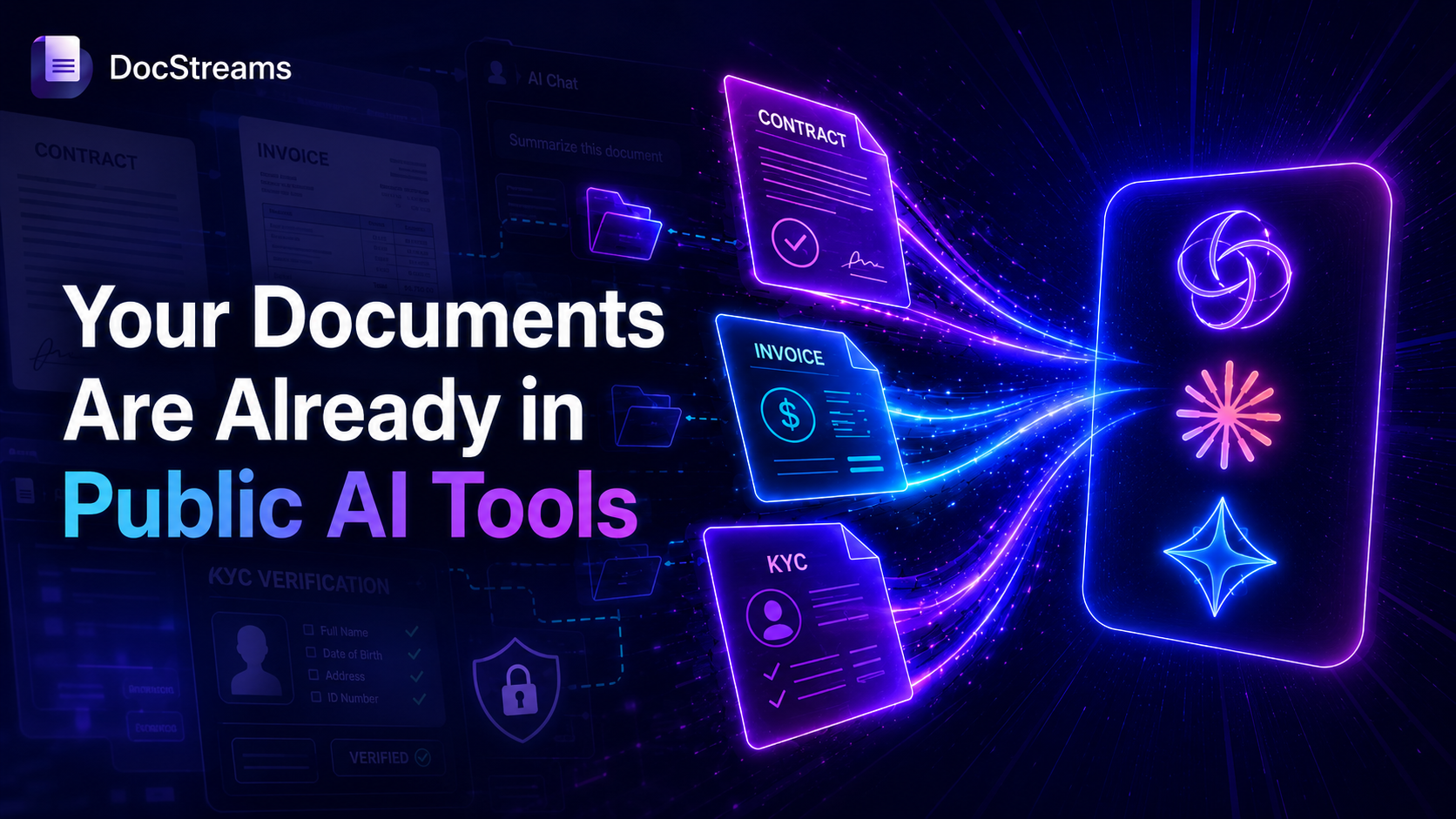
Here's a scenario that plays out every day in mid-market companies. Someone on the finance team gets a 47-page vendor agreement. They need to pull out the payment terms, the liability caps, the auto-renewal clause. Reading through the whole thing takes 40 minutes. So they open a browser tab, paste the document into ChatGPT, and ask for a summary. Four minutes later they have what they need. Nobody told them not to do this. Nobody told them it was a problem.
Multiply that by 20 people. Multiply that by a year.
You're not reading about a data breach. Nothing exploded. But your contracts — the real ones, with real client names, pricing structures, NDA provisions, and commercial terms — have been traveling outside your organization in ways no audit trail will ever catch.
This is the document problem nobody is talking about. Not the compliance angle, not the AI regulation angle. The quiet, daily one.
The numbers are worse than you think
A 2026 survey by CamoCopy covering 2,000 professionals found that 70% of employees are using AI for work tasks. That's not the alarming part. The alarming part is that 32% are doing it without their employer's knowledge. A separate Lenovo survey of 6,000 enterprise workers, covered by Help Net Security in May 2026, put the number at 1 in 3 employees operating entirely outside IT oversight.
And the documents they're processing aren't generic. They're contracts. KYC files. Invoice batches. HR forms. Internal reports that took months to produce. The LayerX Enterprise AI and SaaS Data Security Report found that GenAI tools are now the number one vector for corporate-to-personal data movement, accounting for 32% of all such transfers.
Here's the thing that makes this so hard to address: the employees doing this are not being careless. They're trying to get through their day. A document that would take an hour to manually process gets handled in four minutes. The productivity case for doing it is obvious. The risk case is invisible — until it isn't.
The problem is how documents actually move through a business
Most conversations about shadow AI focus on the security breach angle. That's real. But there's a second, slower-burning problem that doesn't get enough attention: the sheer volume of manual document work that companies are still doing in 2026, and the improvised ways people are dealing with it.
According to Docsumo's IDP market research, a typical accounts payable employee manually processes around 20 invoices per day. With structured AI document processing, that throughput can increase by 60%. A logistics company cited in the same report cut document processing time from over 7 minutes per file to under 30 seconds.
The gap between what people are doing (pasting into ChatGPT) and what a structured workflow could do (process the same document with a full audit trail, structured extraction, and no data leaving your environment) is exactly where the risk lives. The person pasting the contract isn't the problem. The absence of a better option is.
What "quiet failure" actually looks like
Gartner predicts that more than 40% of agentic AI projects will be canceled by the end of 2027 — not because the technology failed, but because organizations deployed it without proper governance and couldn't account for what happened when it was wrong.
The pattern described by Sirocco Group's back-office agent analysis is worth understanding. When a document processing system makes an error — misclassifies a vendor, misreads a payment term, misses a flag in a contract — it produces no visible error signal. The document looks processed. The work looks done. The mistake sits in the data until someone runs a quarterly reconciliation, or an auditor finds it, or a client complains about something that happened six weeks ago.
This is different from a system crash. You can fix a crash. A silent misclassification across 800 invoices is a different kind of problem.
The same logic applies to the shadow AI scenario. You won't find out that an employee pasted your major client's contract into a public LLM during the quarter it happened. You'll find out — maybe — when a competitor's pitch includes pricing logic that looks a lot like yours. Or you won't find out at all.
What document processing actually costs, when you count it honestly
We work across sectors that look different on the surface — financial services, logistics, oil and gas, HR, retail — and the document problem underneath is almost always the same. Someone is reviewing something manually that does not need to be reviewed manually. They have been doing it for years because there was never a better option that felt safe to use.
The numbers from our live workflows are pretty direct. A retail finance team processing supplier invoices through DocStreams cut 450+ manual hours per month and reduced data errors by 94-97%. A compliance team running KYC onboarding brought their review cycle down by 70-85% and dropped compliance error rates by 90-95%. An oil and gas operator saved over 10,000 staff hours a year on inspection documentation. A logistics client moved from 7-minute manual document handling to under 30 seconds per file, and got paid 12-20 days faster.
None of these came from reducing headcount or simplifying the documents. Every workflow ran at the same volume with the same team. What changed was consistency: every document went through the same extraction process, produced the same structured output, and flagged only what actually needed a human to look at it.
Two things make this different from the ChatGPT-in-a-browser-tab version. First, the model is fully isolated. Your documents do not train anything. Nothing you send through DocStreams goes anywhere outside your workflow — not to improve a shared model, not to a system anyone else can query, not to us beyond what your pipeline requires. You control the data, and that control does not quietly expire after 30 days when someone updates the terms of service.
Second: when a compliance question comes up — a regulator, an auditor, a client disputing a contract clause — "we processed it" is not sufficient. A structured log showing what was extracted, from which field, with what confidence score, at what time, is. That record does not exist if the work happened in a browser tab.
The question isn't whether AI will process your documents
It's already doing it. If your employees are anything like the average across the companies surveyed in 2026, at least a third of them are using personal AI tools on work documents right now. The question is whether that processing happens with governance, consistency, and an audit trail — or in a series of browser tabs that leave no trace except in the training data of a model your competitors can also query.
Most companies don't have a document AI strategy. They have a document AI reality that's happening without one.
A controlled intake — where documents enter through a defined system, get processed with structured extraction, and produce outputs that can be reviewed, corrected, and audited — doesn't require a major infrastructure overhaul. It requires deciding that the uncontrolled version is more expensive than the alternative.
The math on that is usually pretty straightforward. The harder part is knowing that the problem is there in the first place.
DocStreams processes documents with structured AI extraction, full audit trails, and zero data leaving your environment. If you want to see how this applies to your specific workflow, write to us.