
Document Processing AI 7 min read
Your AI Agent Can Read the Document. But Can It Prove the Decision?
 Ilona Yarmolovska
 In 2026, enterprise AI is no longer just reading documents. It is starting to influence approvals, claims, payments, compliance checks, and operational decisions. That makes one thing critical: every answer, field, and recommendation must be traceable back to the source document.
Ilona Yarmolovska 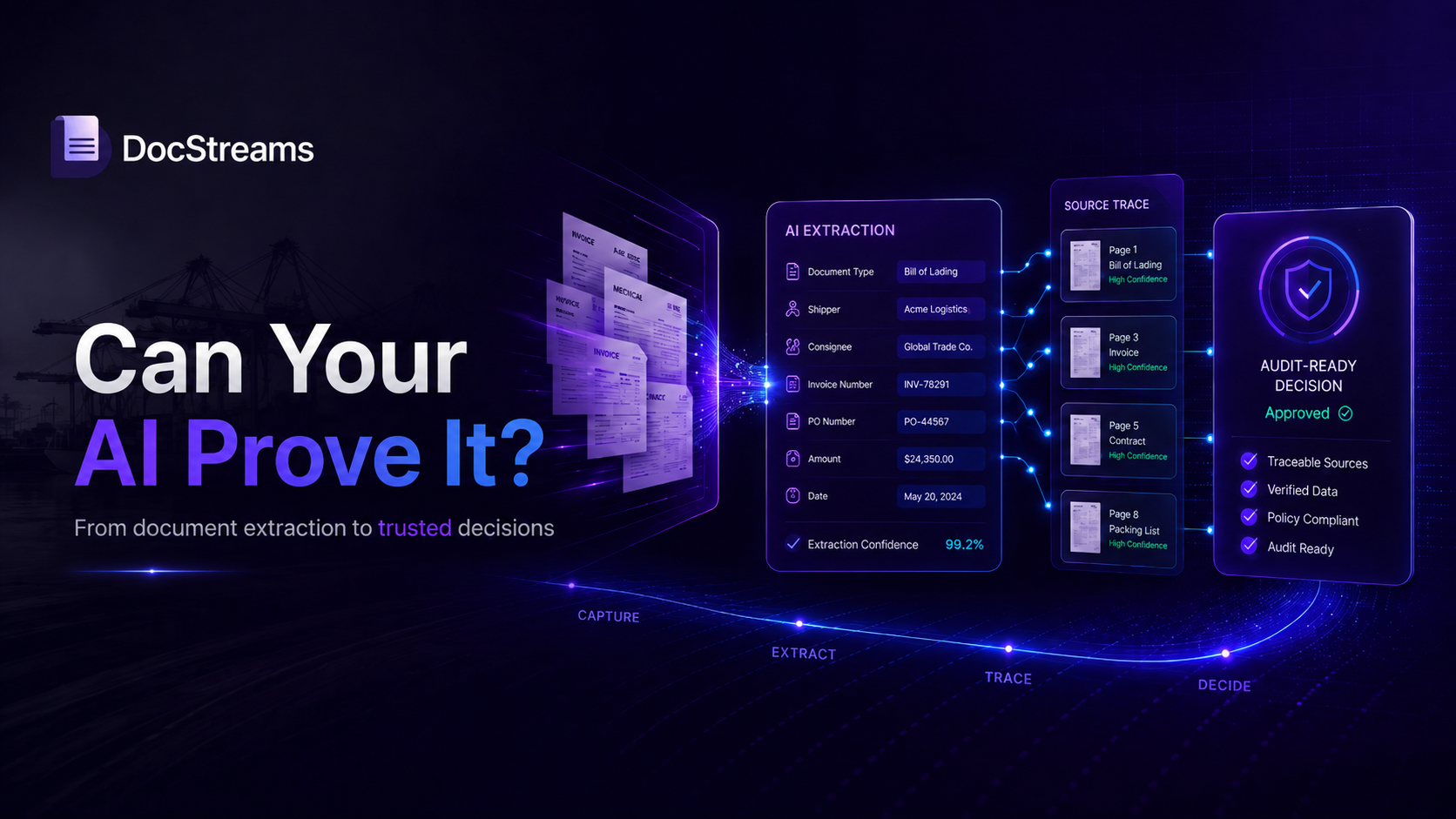
For the last few years, the conversation around AI document processing was mostly about extraction. Can the system read this invoice? Can it pull data from a scanned PDF? Can it classify a contract, a medical record, a field ticket, a bill of lading, or a CV without someone copying fields by hand?
That was a real problem. In many companies, it still is. But in 2026, extraction alone is no longer the interesting part. The bigger question is what happens after the document has been read.
Enterprise AI is moving into workflows. Not side experiments. Not a chatbot that sits next to the business and answers harmless questions. Real workflows: payment approvals, prior authorization reviews, shipment checks, compliance monitoring, claims handling, supplier onboarding, field service reporting. In May 2026, Reuters reported that companies are shifting from individual AI use to enterprise-scale deployment, where AI is not just added to existing tools but starts reshaping how work gets done.
That is the part many teams underestimate. A workflow is not just a screen, a prompt, or a model. It is a chain of evidence, decisions, approvals, exceptions, and systems that need to hold up under pressure. And most of those workflows still begin with documents: invoices, PDFs, scans, emails, attachments, contracts, addenda, medical notes, inspection reports, customs files, proof of delivery, policy documents, supplier forms, and claims evidence.
If that document layer is messy, the AI layer will be messy too. It may look faster. It may sound confident. But it will still be working from unstable ground.
The next problem is not reading documents. It is trusting decisions.
A human can look at a document and notice when something feels off: this version is old, this amount does not match the purchase order, the clause is in the addendum rather than the main contract, the supporting file is missing. AI can help with that, but only when the workflow around it is designed properly.
That is why the old promise of document automation is becoming too small. “We extract fields from PDFs” is useful, but it does not answer the questions enterprise teams are now asking. Can we prove where this field came from? Can we show which page, clause, line, or attachment supported the recommendation? Can we explain why the document was routed for review? Can we see who approved it, when, and based on what evidence? Can we stop an AI workflow from acting on incomplete or low-confidence data?
This is the real 2026 shift: from document extraction to document decisions.
AI agents make the document problem sharper
AI agents are being discussed everywhere because they promise something stronger than automation. They do not only summarize or extract. They can plan, recommend, trigger actions, update systems, draft messages, route tasks, and coordinate across tools.
That changes the risk profile. A read-only assistant that helps someone find a clause is one thing. An agent that updates an ERP record, approves a claim, sends a supplier response, or flags a medical request is another. Gartner’s 2026 guidance, covered by ITPro in May, points to exactly this issue: agent governance cannot be one-size-fits-all. A simple retrieval agent and an autonomous workflow agent should not have the same access, controls, or approval logic.
For document-heavy workflows, that governance starts before the agent acts. It starts with the file. Was the document correctly classified? Was the text read accurately? Were the key fields extracted with enough confidence? Were business rules applied? Was the answer grounded in the right source? Was a human asked to review the exception?
The agent is only as trustworthy as the document process feeding it.
A document workflow now needs an audit trail by design
Auditability used to sound like a back-office concern. Something for compliance teams, finance controllers, legal departments, or healthcare administrators. In 2026, it is becoming a product requirement for enterprise AI.
The European Commission’s VAT in the Digital Age programme is a useful signal. The ViDA 2026 Work Programme, published in May 2026, continues the move toward more structured digital reporting and e-invoicing across the EU. On its VAT in the Digital Age page, the Commission says e-invoicing could help reduce VAT fraud by up to €11 billion a year and reduce administrative and compliance costs for EU traders by more than €4.1 billion annually over ten years.
That is not only a tax story. It shows where business documentation is heading: structured data, clearer evidence, faster reporting, and less tolerance for manual ambiguity.
Healthcare is moving in a similar direction. The CMS WISeR model describes the use of enhanced technologies to improve review of selected services vulnerable to fraud, waste, and abuse. Whether an organization is looking at prior authorization, claims review, or medical necessity checks, the operational lesson is the same: the quality of the decision depends on the quality of the documentation package behind it.
Logistics has the same pattern. A shipment may be “digital” in one system, but the evidence around it is still scattered across contracts, CMRs, proof-of-delivery files, customs documents, insurance papers, email attachments, and photos. A claim can fall apart because the right document exists somewhere but cannot be found, connected, or verified quickly enough.
This is where companies often get AI wrong. They try to automate the final action while leaving the evidence layer untouched. That does not create reliable automation. It creates fast uncertainty.
What an audit-ready document layer should do
An audit-ready document layer is not just storage. It is not a shared folder with better search. It is also not OCR with a modern UI. It is the operational layer that turns incoming documents into structured, validated, traceable workflow data.
It starts with controlled intake. Documents arrive from email, portals, uploads, scans, mobile photos, system exports, and partner channels. The workflow needs to know what came in, when, from whom, and under which process. Then it needs correct classification, because an invoice, delivery note, insurance certificate, inspection report, CV, and contract addendum do not follow the same business logic. They require different fields, validation rules, routing paths, and review thresholds.
The next step is structured extraction with source preservation. The business needs the extracted value, but it also needs the evidence behind that value. If a payment term was extracted from page 4, that page should be available. If a clause came from an addendum, the workflow should not treat it as if it came from the main contract. If a field is low-confidence, the system should not quietly push it into the next step as if nothing happened.
Validation is where document automation becomes operationally serious. Does the invoice total match the purchase order? Does the shipment route match the contract? Is the certificate expired? Is the required clinical documentation attached? Is the candidate summary based on the actual CV, not generic assumptions? These checks are not small details. They are the difference between automation that saves time and automation that creates hidden risk.
And when something does not match, the system should route the exception to a person. The goal is not to remove humans from every decision. The goal is to stop wasting their time on clean cases and bring them in when judgment is actually needed.
Finally, the workflow should leave a usable trail: inputs, extracted values, confidence, validations, human approvals, system actions, and source references. That is the difference between “AI helped us process the document” and “we can defend the decision.”
Where DocStreams fits
DocStreams was built for the part of AI transformation that sounds less glamorous but decides whether the workflow actually works. It turns messy business documents into structured, reviewable, usable workflow data.
In one inspection and asset-integrity case, DocStreams implemented an end-to-end document automation pipeline that standardized formatting, extracted operational data into structured records, automated approval routing, and added a conversational AI agent for field-work data queries. Over nine months, the organization reduced document processing turnaround by 82% and saved approximately 10,000 staff hours per year.
The important part is not only the percentage. The important part is the pattern. Documents did not just become searchable. They became part of a controlled workflow: intake, extraction, structure, routing, approvals, governance, and access to answers.
That is where document automation becomes enterprise infrastructure.
The same logic applies across other document-heavy operations. In finance, DocStreams can support invoice intake, extraction, validation, and exception review before data reaches accounting systems. In healthcare, it can help structure documentation packages for review instead of leaving teams to chase missing files manually. In logistics, it can connect fragmented shipment evidence before claims, customs, or partner disputes become expensive delays. In recruitment or HR operations, it can turn CVs and supporting documents into consistent, reviewable summaries rather than forcing teams to compare unstructured files one by one.
This is also where source-grounded document assistants become useful, but only as part of the broader document workflow. For example, Archidex shows how an AI assistant can answer questions across company documents while pointing users back to the source document, page, and passage. That same principle matters for DocStreams: enterprise AI should not float above company documents. It should be grounded in them, and every important output should be traceable.
The uncomfortable truth: AI will expose document chaos faster
Many companies hope AI will clean up years of document disorder by itself. Usually, it does the opposite. It reveals the mess.
The same contract exists in five versions. The invoice is missing the supporting delivery note. The field report has handwritten values that were never validated. The policy was updated, but the old template is still being used. The claims evidence is split between email, folders, and a legacy system. The approval happened in chat, but the system of record says nothing.
A human team can work around this slowly. They ask colleagues, search inboxes, compare files, and rely on memory. AI works differently. It needs clear inputs, permissions, context, and rules. Without those, it may produce answers that look polished but are difficult to verify.
That is why the next generation of document automation will be judged less by demos and more by operating reality. Can it handle ugly documents? Can it work with existing systems? Can it separate clean cases from exceptions? Can it show sources? Can it support human review? Can it create a record strong enough for finance, legal, operations, or compliance?
If not, it is not ready for serious workflows.
The future is not paperless. It is evidence-led.
The dream of the paperless office has been around for decades. It never fully arrived because business did not stop producing documents. It only changed the formats. Paper became PDFs. PDFs became email attachments. Attachments became portal uploads. Forms became scans. Approvals became messages. Evidence became scattered.
So the better goal is not “paperless.” The better goal is evidence-led operations.
Every field has a source. Every recommendation can be checked. Every exception has a reason. Every approval has context. Every AI-assisted decision can be traced back to the document that supported it.
This is where AI document processing becomes much more than automation. It becomes the trust layer for enterprise AI.
In 2026, companies will not win by giving agents more documents and hoping for the best. They will win by building document workflows that agents, humans, and systems can all trust.
The AI agent may be able to read the document. The real test is whether the business can prove the decision.