
Document Processing AI 6 min read
Why Shipping Documents Are Going Digital in 2026: From BoL to ETA
 Ilona Yarmolovska
 Shipping documents are finally going digital. Here’s why eBL adoption, AI document automation, and real-time data visibility are becoming critical for logistics teams in 2026
Ilona Yarmolovska 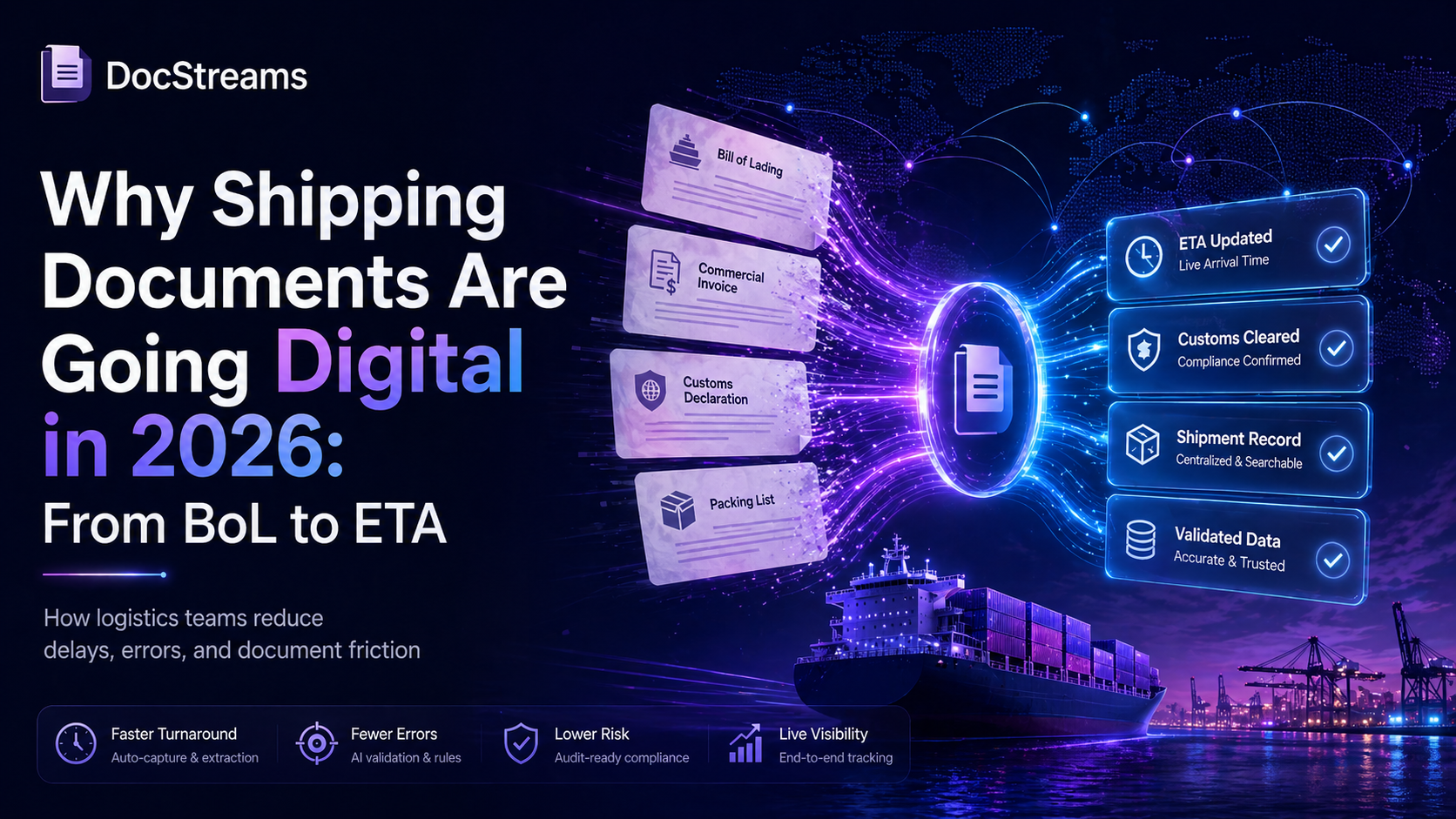
A truck is waiting at a border crossing. The cargo is perishable. The driver has the paperwork, or at least believes he does. One document is in a format the broker’s system cannot process. Another version of the bill of lading is still moving between inboxes, platforms, and people. Nothing is technically “missing”, but nothing moves until the data is correct.
This is not a story from 2010. It is the standard operational reality for thousands of shipments in 2026. And according to industry data, inaccurate or missing documentation accounts for approximately 80% of all border holds. The number one cause of customs delays is not congestion, not geopolitical disruptions, not port capacity. It is paperwork.
Yet as of 2025, only around 11% of bills of lading worldwide are issued electronically.
That gap - between where the technology stands and where adoption actually is - is closing in 2026. Here is what is driving it, what the numbers show, and what it means for your operations team.
What a Bill of Lading Actually Does (and Why Paper Has Survived 600 Years)
The bill of lading (BoL) is one of the oldest commercial documents still in daily use. It serves three simultaneous functions: a receipt confirming the carrier has taken the goods, a contract of carriage setting out the terms between shipper and carrier, and - critically - a title document that transfers legal ownership of the cargo.
That last function is why paper persisted for so long. Transferring title traditionally required a physical original. The document had to travel - often by courier, sometimes across multiple continents - to reach the consignee before the vessel did. When it arrived late, cargo sat at port. When it got lost, the legal resolution could take months.
According to McKinsey, a single paper bill of lading involves up to 50 sheets of paper exchanged with up to 30 different stakeholders across its lifecycle. The BoL process applies to roughly 40% of all containerized trade transactions globally. The estimated cost of this system runs into billions in avoidable friction every year.
The Legal Barrier Is Finally Falling
The main obstacle to electronic bills of lading was never the technology. It was the law. For an eBL to replace a paper original, national jurisdictions needed to recognize electronic transferable records as legally equivalent. Most did not - until recently.
The shift traces back to the UNCITRAL Model Law on Electronic Transferable Records (MLETR), adopted in 2017 but slow to enter national legislation. That changed between 2023 and 2026 in a meaningful way.
The UK passed its Electronic Trade Documents Act in 2023, giving eBLs full legal standing equivalent to paper originals. Singapore followed. France became the first EU member state to fully transpose MLETR into domestic law in 2025, through Decree No. 2025-811. Japan is amending its Commercial Code to permit eBLs, with implementation expected in fiscal year 2026. Bahrain, the Abu Dhabi Global Market in the UAE, Papua New Guinea, and Belize have all enacted MLETR-aligned legislation.
This is no longer a fringe legal experiment. The legal infrastructure for paperless trade is being built in real time, across the economies that handle the majority of global trade volume.
Three Numbers That Show Where the Industry Actually Stands
25.1% — the average eBL adoption rate achieved by BHP, Rio Tinto, Vale, and Anglo American in iron ore trade under BIMCO’s “25 by 25” campaign, which asked participants to use electronic bills of lading for at least 25% of shipments of one commodity by 2025.
49.2% - The overall eBL adoption rate recorded in the FIT Alliance 2024 annual survey, up from 33% in 2022. Nearly half of respondents now use eBLs in some capacity - and 74.7% of paper-only users say they plan to transition.
2030 - The DCSA's target year for full standardized eBL adoption across its member carriers, which collectively represent 70% of global containerized trade. In May 2025, DCSA completed its first standards-based, interoperable eBL transaction - the first time two separate eBL platforms exchanged a live document without any manual intervention. That milestone matters because platform interoperability was the final technical blocker.
The trajectory is clear. The question for COOs is not whether this transition will happen. It is whether their operations will be ready when the standardization pressure arrives.
The $6.5 Billion Opportunity - and Who Captures It
McKinsey's analysis puts direct transaction cost savings from universal eBL adoption at $6.5 billion annually for all stakeholders. Broader estimates reach $18 billion in direct ecosystem savings from faster document handling and error reduction, plus $30 to $40 billion in incremental global trade growth from reduced friction across supply chains.
On the trade finance side, document delays currently account for 23% of all trade finance disputes, with an average cost of $75,000 per incident for medium-sized transactions. eBLs cut error rates and eliminate courier cycles, which reduces dispute rates directly.
Customs clearance tells the same story. When documentation is digitized and accurate, goods can clear customs before a vessel even berths at port. With paper documentation and any errors, clearance can stretch to days. The difference in effective transit time determines whether perishable cargo arrives sellable, whether letters of credit expire, and in some cases, whether a client relationship survives.
The eBL market itself reflects this direction. Valued at $2.8 billion in 2025, it is projected to reach $9.6 billion by 2034, growing at a CAGR of 14.7%.
Why Most Carriers Cannot Just "Switch to eBL"
Here is where the gap between the headline opportunity and operational reality sits.
The major eBL platforms - Bolero, essDOCS, WAVE BL, CargoX, edoxOnline - achieved standards-based interoperability only as of May 2025's DCSA milestone, and only in DCSA-compliant configurations. Most smaller carriers and freight forwarders operate legacy TMS, ERP, and customs filing systems that were not designed for electronic transferable records. They cannot adopt an eBL platform without first resolving how documents will be processed, validated, and integrated into existing downstream workflows.
This is not a niche problem. It describes the operational reality of the majority of the shipping industry outside the top 10 global carriers. The paper document disappears, but the data that was in the paper still needs to go somewhere - accurately, completely, and in the right format for each downstream system.
The practical approach being deployed in 2026 is a document intelligence layer positioned between the eBL or mixed-format document flow and the carrier's or forwarder's existing systems. Instead of replacing the TMS or waiting for full industry standardization, this layer reads incoming documents - whether native eBL, scanned PDF, structured data from a partner platform, or customs-specific formats - extracts the relevant fields (shipper, consignee, cargo description, HS codes, port of loading, port of discharge, incoterms), validates them against the shipment record, and feeds clean structured data into the downstream workflow.
For legacy carriers, this approach eliminates the manual data entry step that generates the majority of documentation errors - without requiring a full system replacement. For brokers and freight forwarders, it means handling eBL-native shipments and paper-based shipments through the same process, which matters because mixed-format trade will remain the norm for at least the next decade as legislation and adoption rates vary by corridor.
Three Questions Worth Asking Your Operations Team Now
The legal framework is moving. The industry majors have committed. The economics are not complicated. What separates operations teams that will benefit from those that will scramble to catch up is whether they have examined their document workflows before the standardization pressure arrives.
Where does manual document handling create the most delay or error in your current workflow? For most operations, the answer is customs documentation and pre-arrival filing - where incomplete or incorrectly formatted data triggers holds. Mapping this accurately takes a few days and does not require any technology investment to start.
Which of your trade lanes are moving fastest toward eBL adoption? Asia-Europe container routes and bulk commodity trades involving major mining companies are furthest along. If those lanes are significant for your volumes, the question of eBL readiness is more immediate than it might appear on the planning horizon.
What would accurate, real-time document data enable that you cannot do today? ETA visibility depends on customs clearance status. Customs clearance status depends on document accuracy. The chain is direct. Teams with visibility into their document flow in real time make better freight decisions - faster rerouting, earlier exception management, tighter carrier SLA tracking.
Key Takeaways
- Paper bills of lading cause the majority of border holds and customs delays. Inaccurate documentation accounts for roughly 80% of all holds. The operational cost is measurable and avoidable.
- Legal infrastructure for eBLs is now in place across major trading economies: UK, Singapore, France, the UAE's ADGM, and - by fiscal year 2026 - Japan.
- Industry adoption is accelerating: 49.2% of shippers now use eBLs in some form (FIT Alliance 2024), and DCSA members representing 70% of container trade have committed to full standards adoption by 2030.
- McKinsey estimates $6.5 billion in direct transaction savings from universal eBL adoption, with broader trade value unlocked reaching $30 to $40 billion.
- Most carriers cannot switch to eBL without addressing legacy document processing infrastructure first. A document intelligence layer is the practical transition approach in 2026, bridging mixed-format trade until standardization catches up.
DocStreams automates document processing for logistics, compliance, and operations teams. If your team handles mixed-format shipping documentation and you want to see what a smarter intake layer looks like in practice, reach out directly.