
AI Document Processing 4 min read
Field tickets and inspection reports: the paperwork problem 2026 made impossible to ignore
 Ilona Yarmolovska
 Manual field tickets and inspection reports still slow down oil and gas teams, creating delays, audit risks, and lost data. Here’s how document AI turns messy paperwork into traceable, structured workflows within weeks
Ilona Yarmolovska 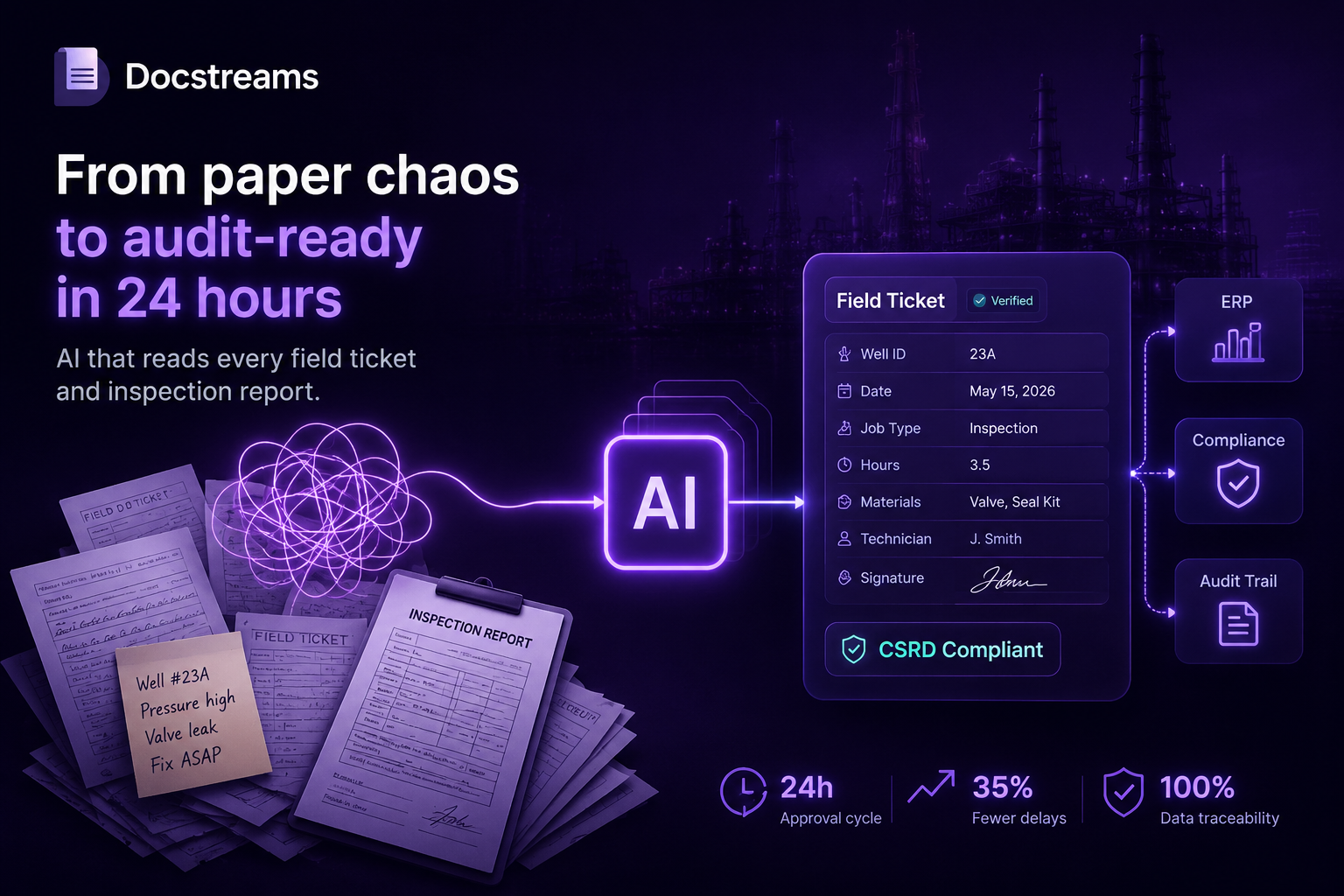
At the end of a shift on an upstream site, a technician gets back from rounds, opens a laptop, and starts copying notes from a paper pad into Excel. Then into the ops system. Then sends an email for approval. Somewhere in those three steps, a few lines about a pressure anomaly disappear into an email thread.
This is not a story from 2015. It's happening now, in most upstream and midstream companies.
The paper that costs millions
A field ticket documents work done: labor hours, materials, equipment, signatures. An inspection report captures asset condition: defects, compliance status, recommendations. Together they're supposed to be the operational memory of an oil and gas company.
For most companies, that memory lives in paper folders or disconnected Excel files.
According to Petro Industry News, downtime caused by lost or incorrectly processed documents costs oil and gas companies an average of $42 million a year, and up to $88 million in the worst cases. Not spills. Not equipment failures. Just paperwork in the wrong place at the wrong time.
A Consultancy.eu study that surveyed 3,750 employees across the US, UK, Germany, and the Netherlands found that roughly half of working time goes to inefficient processes: excessive email, no standard procedures, manual coordination. For inspectors on oil and gas sites, that checks out.
What changed in 2026
For years, "we don't have the budget" or "that's how we've always done it" held the line. Two things made those arguments harder in 2026.
The first is regulatory. CSRD now requires companies in scope to have verified emissions reporting, and the key requirement is data traceability — every figure in the report has to link back to a primary source document: meter readings, fuel logs, equipment maintenance records. Normative notes that auditors specifically look for this chain, from the number in the report to the actual inspection log or equipment reading. If the field ticket was handwritten and lives in a folder, the chain doesn't exist.
The second is competitive. The digital oilfield market is projected to hit $34 billion in 2026, growing to $48.4 billion by 2034. Companies that don't digitize aren't falling behind on technology — they're falling behind on service cost.
Where most companies get stuck
Most conversations about digitizing inspection documentation stall in predictable places.
"We have Excel." Yes. But the inspector fills out a notebook in the field, transfers it to Excel at the office, and then someone copies that into the ERP. The same row gets entered three times, with three chances for error.
"We send photos." Fine. But a WhatsApp photo isn't a verifiable document for a compliance audit. And finding the right report eight months later in a chat thread is its own problem.
"We already have a system." Maybe. But if it can't read non-standard forms from subcontractors, can't handle handwritten notes, and isn't connected to the ERP — it's a scanner with a subscription fee, not a solution.
FTQ360, which builds inspection software for O&G, documented three recurring time wasters in inspection workflows: spreadsheet dependency, manual non-conformance tracking through email, and no standard process for follow-up. The outcome is predictable: inspectors spend more time on paperwork than on the inspection itself.
What this looks like in practice
A situation we run into often at Docstreams: a company services several hundred wells. Each subcontractor uses its own field ticket format. One submits PDFs, one sends Word files, one shows up with a handwritten A4 sheet. Every week the back office gets around 300 documents in different formats, and someone has to pull the same fields from each: date, well ID, job type, hours, materials, signature.
Before document AI: two administrators spent 3-4 hours a day on data entry. Approval cycle: up to three weeks.
After: one pipeline ingests documents regardless of format, extracts the structured data, and routes only anomalies for human review. Approval dropped to 24 hours.
The industry data runs the same direction. Companies that have moved to digital field ticketing report 35% fewer operational delays and 30% higher field personnel productivity on average. A FieldEquip case study on a mid-size well production chemical company with 5,000+ wells in Texas and Louisiana documented 500+ saved labor hours and a 22% improvement in inventory management efficiency after full digitization.
Four steps, not a year-long project
The assumption that holds most companies back is that digitizing inspection documents means a big ERP integration, staff retraining, and a 12-month rollout. It doesn't have to be.
The first step is consolidating inputs — email, mobile app, scanner, photos — into one place. Subcontractors don't need to change their forms. Document AI reads what's already there.
The second is automatic data extraction. The system pulls the same fields — date, ID, job type, materials, signature — regardless of whether the source is a PDF, a Word file, or a photo of a handwritten sheet. Manual entry goes away here.
The third is routing only exceptions. Around 80% of documents go through without anyone touching them. The 20% with anomalies or illegible fields get flagged. People only look at things that actually need a decision.
The fourth is a traceable archive. Every document is stored with metadata: who uploaded it, when, what status, which version. When a CSRD audit or internal review comes around, finding a specific record from eight months ago takes seconds, not days.
Before you close this tab
How many hours does your team spend on manual field ticket processing each week? Can you prove to an auditor today that the inspection record from last November is the version the subcontractor actually signed?
If either of those doesn't have a quick answer, it's worth looking at where document AI fits — not as a transformation project, but as a specific fix with a measurable result in four to six weeks.
At Docstreams, we start with a document flow audit: what's coming in, how many formats, where the delays are. The picture usually gets clear in the first conversation.
Where does the most time go in your field documentation process? Drop a comment, or send a message — happy to show you what it looks like for your specific setup.